Prior authorization · IBD biologics
The whole chart, read.
Every claim, cited.
Meleia reads the full records packet — every office visit, lab, and half-legible fax — checks it against the payer's own criteria, and returns a reviewable case in minutes. Every finding links to the exact page it came from. Your team reviews and decides; nothing leaves the clinic without sign-off.
26 of 26 quotes mechanically matched to their source pages before anything is shown to your team.
The TNF-failure evidence lives in three documents, one of them a fax — so it's routed to a human, not rounded up to “met.”
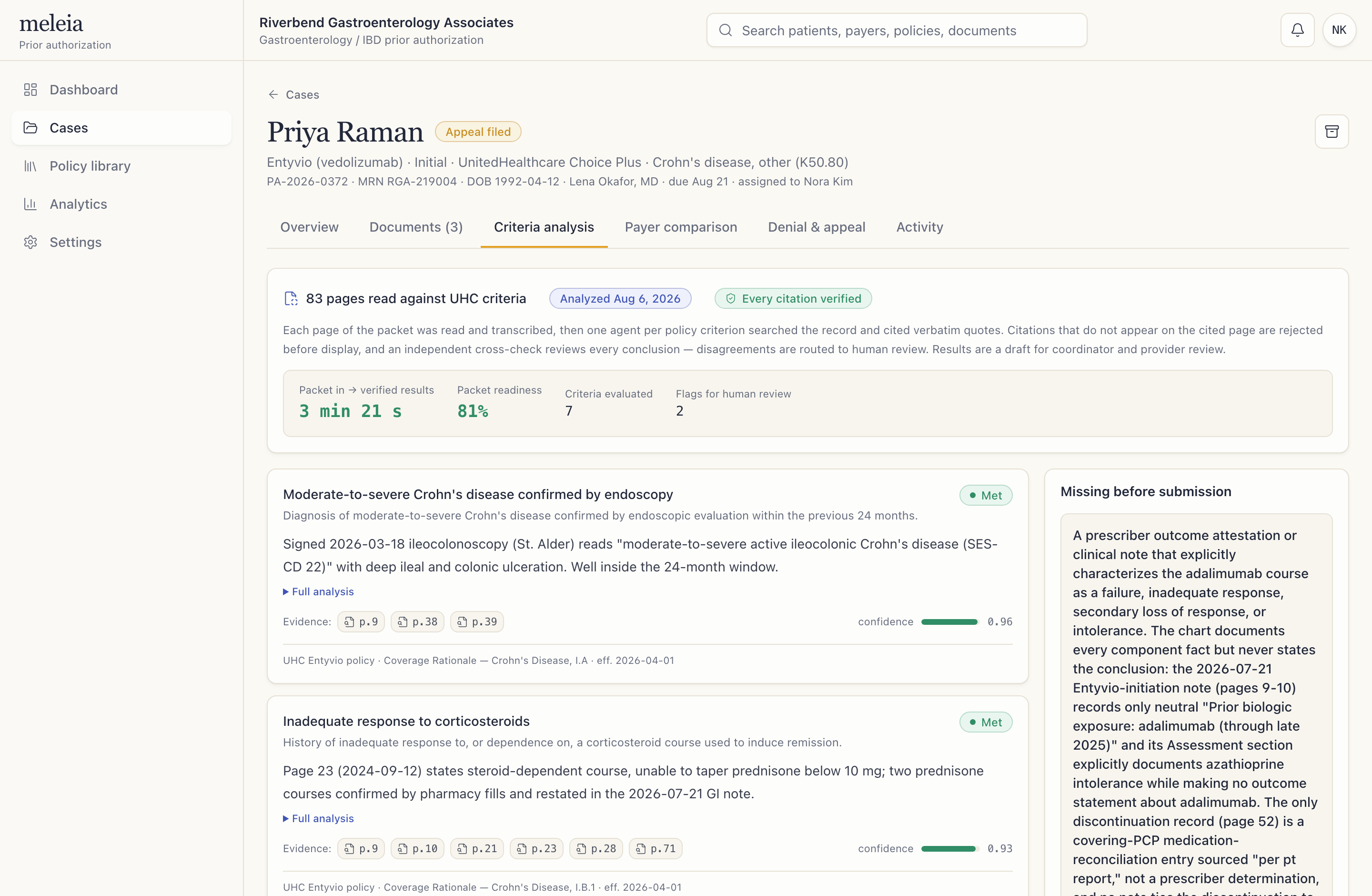
The console after a real run — 83 pages in, cited results in 3 min 54 s. Sample patient data shown.
Three minutes, twenty-one seconds — watched live, stage by stage.
This is the run that produced the case above, replayed: the packet is split and read page by page, one agent per policy criterion searches the record, and every quote is verified against its source before your team sees it.
The fax on page 52 — one line, half-legible, decisive — is exactly the kind of thing that sinks a prior auth. It gets caught here.
Answers you can interrogate, down to the line on the page.
Three views from the same case — the analysis your coordinator reviews, the evidence behind one finding, and what happens when the payer says no.
Seven criteria, each argued like a careful colleague would.
Every criterion gets a short reviewer summary, a confidence score, and page-level citations — with the full analysis one click deeper. Ambiguity is flagged, not smoothed over, and every gap ships with a concrete fix your staff can act on today — down to the one-line attestation, already drafted.
Shown: three of the seven criteria from the replayed run.
Signed 2026-03-18 ileocolonoscopy reads “moderate-to-severe active ileocolonic Crohn's disease (SES-CD 22)” with deep ulceration. Well inside the window.
Labs fit adalimumab failure — trough 2.1 µg/mL with anti-drug antibodies — but no clinician states it outright. A reviewer must adjudicate before submission.
Gaps are named precisely — not “documentation insufficient,” but which note, from which visit, needs which sentence.
Click a citation. The actual page opens, lines highlighted.
This is the interaction that changes the review conversation: instead of trusting a summary, your coordinator interrogates it. Each evidence chip opens the cited page — including the degraded fax where one line settles the whole criterion.
Try it — the chips below are live.
Reports 6-8 loose stools daily with urgency and nocturnal
symptoms 6-8 weeks despite adalimumab 40 mg every other week with documented adherence (specialty pharmacy fill records reviewed). Weight down 2.1 kg since January visit. CRP rising on serial labs.
MEDICATION RECONCILIATION FORM encounter 11/04/2025
pt: RAMAN, P. dob 04/12/1992
MEDICATIONS REMOVED THIS ENCOUNTER adalimumab 40 mg SC every other week — DISCONTINUED per pt report ferrous sulfate 325 mg on hold, GI upset
reconciled by: J. Alvarez, RN reviewed: M. Yee, DO
ADALIMUMAB TROUGH LEVEL ...... 2.1 ug/mL (target >= 7.5) LOW ANTI-ADALIMUMAB ANTIBODY ..... 58 AU/mL (ref < 20) HIGH
C-REACTIVE PROTEIN ........... 21.7 mg/L (ref < 5.0) HIGH
FECAL CALPROTECTIN ........... 512 ug/g (ref < 50) HIGH
When the denial letter arrives, the appeal is already half-written.
Attach the adverse determination and Meleia parses each reason code, maps it to the policy criterion it targets, and drafts a point-by-point response citing the payer's own policy language and the chart pages that answer it — plus a one-page prep card for the physician's peer-to-peer call.
Shown: the real UM-104 step-therapy denial from the replayed case, answered.
“…does not establish failure of, inadequate response to, or intolerance of at least one TNF inhibitor…”
The record documents this requirement across three documents: biologic initiation (p.21), symptom recurrence on therapy (p.17), and discontinuation (p.52) — corroborated by therapeutic drug monitoring (p.57). A signed outcome statement accompanies this appeal.
Anticipated objection, suggested response, and the dated evidence sequence — on one page, ready before the call is even scheduled.
One case, start to finish — the way your office actually works.
Meleia follows the case through its whole life, not just the analysis: it drafts at every step, and your team signs at every step.
Case created
Patient, coverage, and requested therapy — the payer policy matches automatically.
Records attached
Drag the packet in, preview every page. Analysis starts only when a human says so.
Analysis runs
Pages read, criteria checked, citations verified — watched live, stage by stage.
Human review
Flags adjudicated, fixes ordered, provider signs. Nothing moves without sign-off.
Submitted
Packet, necessity letter, and fax cover assembled from the analysis.
Decision recorded
Approved — done. Denied — the letter is parsed against the policy on file.
Appeal drafted
Point-by-point response plus the physician's peer-to-peer prep card.
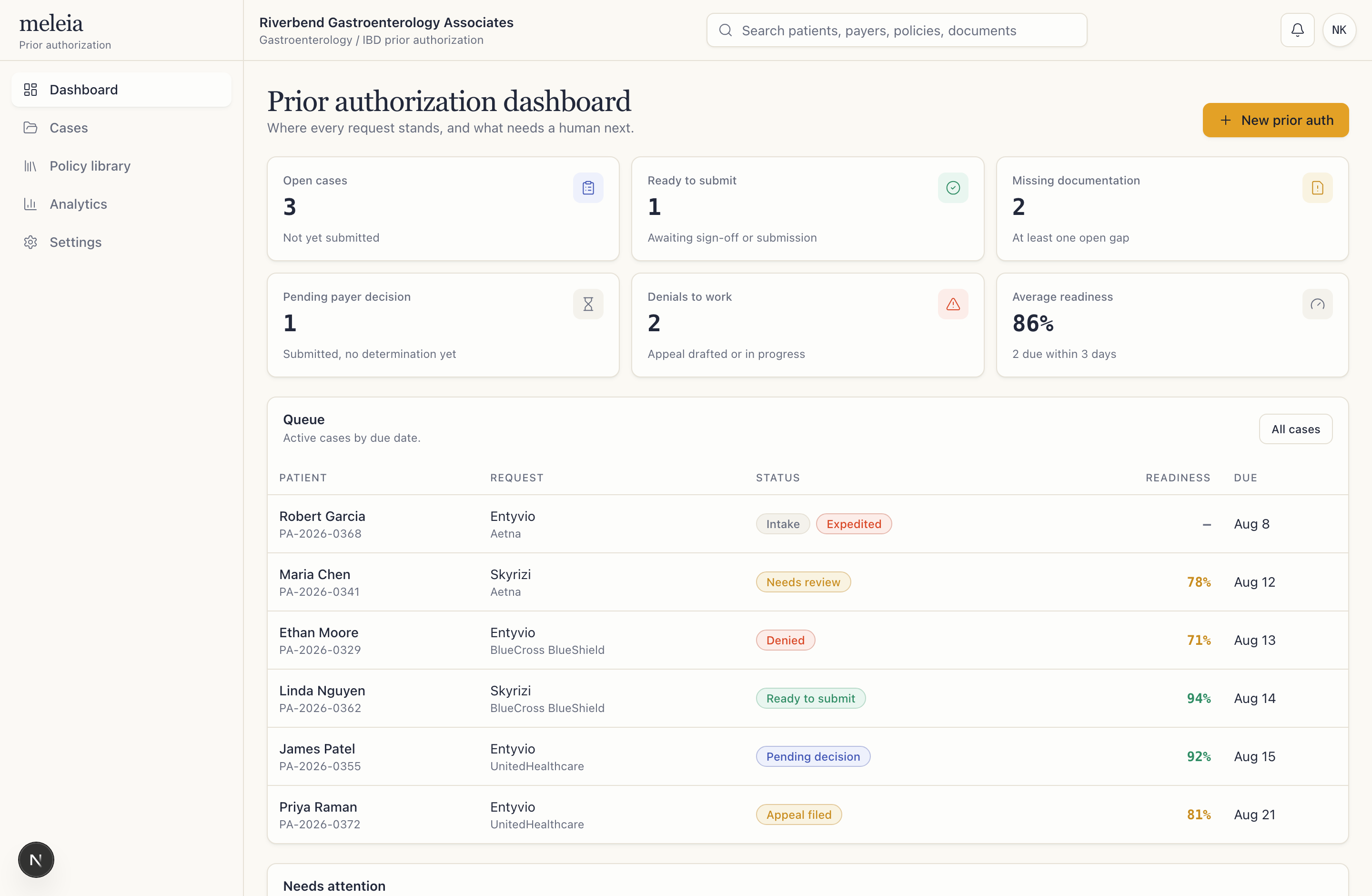
The queue your coordinators actually live in — every request, its readiness, and what needs a human next.
Built for the questions your administrator asks first.
The compliance conversation shouldn't start after the demo. Here are the answers upfront, the way we'd put them in a contract.
De-identified by default
Evaluation — including the chart challenge — runs exclusively on de-identified records. No PHI touches Meleia until your practice decides it should, under a signed BAA.
BAA & zero retention
Pilots run under a business associate agreement with processing configured for zero data retention. We walk your administrator through the full data-flow diagram before anything starts.
Your team holds the pen
Payer criteria are validated by your staff before they're used. Every letter and packet is a draft until a coordinator and provider sign it. Meleia never submits on its own.
Clinical software earns trust by being checkable.
“The question isn't whether software can read a chart. It's whether your coordinator can look at what it found, click through to the page, and stake their name on it.”
Every claim is a link
No finding without a citation, no citation without verification. If it isn't on the page, it isn't in the result.
Uncertainty is surfaced, not smoothed
Scattered, implicit evidence gets flagged “needs review” with its confidence shown — never silently rounded up to met.
People sign, software drafts
Meleia never submits anything. Coordinators and providers review, edit, and sign every packet and letter that leaves the clinic.
Prior authorization for a biologic shouldn't take a coordinator three hours of page-flipping and a physician's evening — and it definitely shouldn't fail because the one line that proves TNF failure was sitting in a fax nobody had time to squint at.
So we built the tool we'd want in that chair: one that reads everything, shows its work, admits what it isn't sure about, and hands your team a case they can defend.
We're opening a small number of design-partner slots for GI practices right now. If the chart challenge below sounds like a fair test, I'd love to run it on your packets.
— Adhrith VutukuriFounder, Meleia · adhrith@meleiahealth.com
Don't take a demo's word for it. Send us your ugliest packets.
- Pick three recent prior auths — ideally ones that were denied or dragged on for weeks.
- De-identify them. During evaluation we only ever handle de-identified records; a BAA comes with a pilot.
- We return cited criteria checklists within one business day and walk through them with you on a 20-minute call.
If the results aren't obviously useful, we won't email you again. That's the whole deal.
Straight answers to the first five questions.
During evaluation — including the chart challenge — we work exclusively with de-identified records, so no PHI is involved. Pilots run under a signed BAA, with processing configured for zero data retention. We'll walk your administrator through the full data-flow diagram before anything starts.
Today: Entyvio (vedolizumab) and Skyrizi (risankizumab) across UnitedHealthcare, Aetna, and BlueCross BlueShield policy structures. Payer criteria are structured data in Meleia, so onboarding your clinic's top payers and drugs is part of pilot setup — and your team validates every criterion before it's used.
No — by design. Meleia drafts the analysis, the letters, and the appeal; your coordinators and providers review, edit, and sign everything before it goes anywhere. The workflow enforces it: nothing reaches "submitted" without a human action.
Three mechanisms exist precisely for that: verbatim citations are mechanically verified against source pages, and unverifiable quotes are rejected; an independent cross-check reviews every conclusion and routes disagreements to human review; and ambiguous evidence is flagged "needs review" rather than decided. The failure mode is designed to be "asks a human" — not "confidently wrong."
Start with the free chart challenge — three de-identified packets, results in a business day. If it's useful, a 60-day design-partner pilot: we onboard your top payers and medications, your team runs real cases through it, and we measure turnaround time and documentation-gap catch rate together. Pilot pricing is intentionally simple; ask and we'll tell you upfront.